
It’s no secret the floor covering industry has a longer sales cycle than other categories of home furnishings, often requiring more nurturing and additional steps along the customer journey. An important part of that process now includes AI tools to help make an earlier impact and hopefully reduce the time to close a deal. These tools have proven to be helpful in purchases involving multi-component flooring, including ceramic tile.
One of the AI tools doing exactly that is Roomvo, a room visualization platform utilized by more than 7,000 retailers and manufacturers worldwide in the flooring industry, with tile representing one of its fastest-growing categories. “Tile is a high-stakes purchase,” explained Brandon Shidlowski, vice president of sales. “In addition to the product, customers are deciding on grout color, layout patterns and finishes all at once, and it’s expensive to get wrong. Ultimately, hesitation is what kills the sale. Letting someone see the actual tile in their own space instills the confidence required to transact.”
To use the platform, consumers simply upload a photo online from their space, and the tool will generate the new space using the tile selected. Users can further customize the look by adjusting the grout color and width, the lighting and trying different layout patterns.
One of the strengths of Roomvo is that it is built on top of the actual product catalogs, Shidlowski said, so it generates accurate, true-to-life renderings. Attesting to the high-quality renderings is The Tile Shop. When using tools like Gemini, Copilot and ChatGPT, the retailer encountered several critical challenges, including inaccurate scaling, visual hallucinations in patterns and colors and slow processing times. “Roomvo is more consistent, dependable and extremely easy to use compared to every other tool we tried in the past,” said Shehan Ghanchi, senior director of marketing and merchandising at The Tile Shop.
Room visualization tools for ceramic tile have resulted in an increase in demand generation and conversions in the ceramic tile industry. Shidlowski points to the success stories of Roomvo’s customers. On the retailer side, The Tile Shop boosted conversions by 5.8x and more than 1.5 million product views in less than six months. As for the manufacturer side, he pointed out how Cerámica Italia’s sales increased over 40% after launching the visualizer tool.
Major manufacturers like MSI also emphasize the importance of using room visualization tools. “We see visualization as a valuable part of the customer journey, whether someone is beginning their research online or working with a retailer to narrow down selections,” said Sherita Spann, senior website manager at MSI. “With porcelain, one of the biggest benefits is giving consumers greater context. A sample can show color and texture, but a visualizer can help communicate how that selection may influence the feeling of an entire room.”
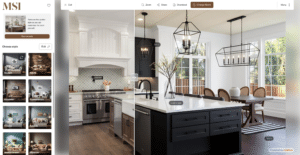
Some of MSI’s room visualization tools (powered by Roomvo) include the AI Inspire tool, where users can upload their image and see their space transformed, as well as a Multi-Surface Visualizer, with a dedicated Kitchen Visualizer and Bath Visualizer, giving shoppers an interactive way to explore its surfaces and see how different design choices can come together. MSI reported that consumers are seeking a personalized experience, citing that 80% of its users upload their own space to the visualizers instead of using the preset room scenes.
Spann describes how the visualizers play a role for two of its ceramic products. “Casa Duet offers a contemporary take on the classic checkerboard look. Its 24 x 24 pre-scored porcelain tiles create the appearance of smaller squares, so being able to visualize that pattern across a larger space can help consumers appreciate the full design effect,” she said. While the Murcia collection “brings together porcelain floor and wall tile with coordinating ceramic wall options, making it easy to create a cohesive design within one collection.”
Another ceramic tile company utilizing visualization technology is Daltile. The company uses the visualization platform, also powered by Roomvo, to allow customers to see their spaces with its products before making a selection. “For ceramic tile, this is especially valuable because customers are making a design decision that can be difficult to envision from a sample or product image alone,” said Paij Thorn-Brooks, vice president of marketing and showrooms.
One of the primary benefits of these tools is confidence. “By making it easier for customers to visualize the finished space, we can help reduce uncertainty and move them further along their purchase journey,” Thorn-Brooks said. “While we do not attribute a specific sales increase solely to visualization, these tools can help create a more informed and confident customer who is better prepared to take the next step with a dealer or designer.”
Digital tools are not intended to replace retailers or design professionals, but they can be an extension of the selling process. Retailers can work with customers to visualize ceramic tile options in the customer’s space to see what works best. “This can make the conversation more productive for both the retailer and customer,” she added. “Instead of simply asking, ‘Which tile do you like?’, the conversation becomes, ‘Which of these options works best in your home?’”
Additional AI tools
Beyond room visualization technology, there are additional AI tools that can help retailers in the buyer journey. A natural next step for consumers is determining how much a flooring project might cost. To aid in this process, Modern Estimates offers MEasure, a photo-based preliminary estimating and lead-qualification platform for flooring retailers.
“This is especially valuable for ceramic and porcelain tile projects because customers often understand the cost of the tile itself but may not anticipate the full installed-project cost,” said Maksim Nazarchuk, founder and president, Modern Estimates. “Removal of the existing floor, preparation of the substrate, setting materials, grout, transitions and installation can all affect the overall budget. MEasure helps begin that pricing conversation before the retailer invests time in an in-home appointment.”
How does MEasure work? On the retailer’s website, customers will submit four photos of their space, their contact info and the flooring they are interested in. “The customer does not need to understand the flooring industry, calculate square footage or know how to measure the room,” Nazarchuk explained. Next, MEasure analyzes the information and produces preliminary pricing for labor and materials using rates established and controlled by the local retailer. The retailer receives the customer’s contact information, project photos, flooring interest, preliminary scope and expected price range.
Nazarchuk believes the simplicity of the customer experience makes it stand out from other products. “MEasure is not intended to replace salespeople, estimators, visualization platforms or final on-site measurements,” he reiterated. “It works earlier in the buying journey, helping retailers identify serious opportunities and giving their sales teams more information before contacting the customer or sending someone to the home.”
Looking forward
Digital tools and AI will continue to play a role in the future of tile flooring, “Consumers are no longer surprised by visualization—they demand it,” Roomvo’s Shidlowski said. “Today, the question a visualizer answers is, ‘What would this look like in my home?’” The next step is helping answer, ‘Which one is actually right for me?’ factoring in room, lighting, and how someone actually lives in the space.”
The post AI assets designed to help RSAs seal the deal appeared first on Floor Covering News.
AI assets designed to help RSAs seal the deal Posted First on https://fcnews.net

No comments:
Post a Comment