 The last 15 years have been a wild ride for ceramic flooring. The industry saw growth for over a decade before the pandemic hit in 2020 and sales dropped significantly—for all categories. However, ceramic experienced a subsequent 8% and 14% expansion in dollars for the next two years, respectively, before beginning the downward trajectory it is still experiencing today. And while ceramic flooring did experience a low-single-digit drop in both dollars and volume in 2025, mainly due to the residential side of the business, it is still slightly above those 2020 numbers.
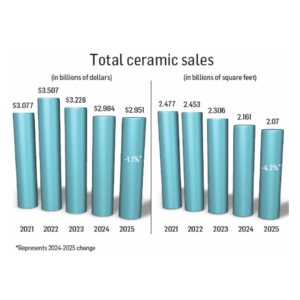
When the dust settled, ceramic experienced about a 1.1% decline in dollars in 2025 to $2.951 billion vs. $2.984 billion in 2024, according to Floor Covering News research. As previously mentioned, ceramic dollars were still up slightly in 2025 when compared to five years ago when the category experienced its first drop in a decade. In 2020, that number was $2.844 billion, down from 2019’s $2.994.
Flooring volume also found itself in the red, registering a 4.2% decline to 2.07 billion square feet from 2.161 billion square feet in 2024, its lowest level since 2014. Ten years ago in 2015 that number was 2.19 billion square feet. The ensuing nine years would see square feet above at least 2.3 billion until the drop in 2024.
The category’s most recent record high was experienced just three years prior in 2022 when dollars were estimated at $3.507 billion (volume was 2.453 billion square feet). These numbers are representative of pandemic-inspired spending, which suppliers agreed pushed demand forward by several years to reach staggering numbers.
The minor comedown since then is not necessarily indicative of an unhealthy category. In fact, looking back nearly 20 years to 2006, ceramic tile was estimated to be $2.464 billion, which would be the high for the next nine years. Last year’s numbers still represent a nearly 18% gain in the last 20 years despite a multi-year decline.
Looking at just the last decade, in 2015 FCNews research showed the ceramic market clocked in at $2.613 billion, which was up 9.3% from 2014’s $2.38 billion. It was the category’s fifth consecutive year of growth, which wouldn’t wane until 2020’s 5% decline in dollar sales and 3.5% decrease in volume from the previous year. That is a 12.2% increase in dollars in the last decade.
The category also kept its standing in 2025 as the third-largest sector in flooring, representing about 12.54% of the flooring industry’s total $23.529 billion. In terms of dollar share that was flat with 2024’s 12.5% share. When it comes to volume, ceramic garnered 12.42% of the flooring industry’s total 16.666 billion square feet sold. That’s also basically flat from 2024’s 12.6% share.
Looking at hard surface alone, ceramic is the second-largest category by dollars and square feet—beaten out only by the behemoth resilient category. Last year, ceramic represented 20.5% of total hard surface dollars, which was $14.669 billion (total). The ceramic category also grabbed 22% of total hard surface volume, which was 9.436 billion square feet. That’s flat from the year prior. Hard surfaces included in this analysis are ceramic, resilient, wood, laminate and rubber flooring.
Ongoing challenges
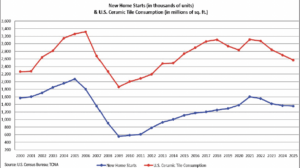
 The ceramic tile category continued to feel the effects of a sluggish housing market throughout 2025. Elevated mortgage rates, affordability challenges and lower existing home sales limited opportunities for both new construction and large-scale remodeling projects, two key demand drivers for tile.
According to the U.S. Census Bureau, total U.S. housing starts reached 1.36 million units in 2025, a 0.8% decrease compared to 2024 and the lowest level since 2019.
“Mortgage rates stayed elevated, with the 30-year fixed rate averaging 6.6%,” said Andrew Whitmire, trade data analyst, Tile Council of North America (TCNA). “Although this was modestly lower than the rate of 6.72% in 2024, it was high by historical standards, continuing to suppress housing affordability and turnover.”
Scott Maslowski, executive vice president of SSC sales & operations, Dal-Tile, agreed, noting, “The primary pressure was a housing slowdown impacted by tariffs, higher-than-expected interest rates and just an overall slowing in regard to consumer confidence. Residential—new residential build, in particular— had the biggest drain.”
While commercial segments and higher-end residential projects provided some stability, many suppliers reported softer volume as builders remained cautious with new housing starts further impacting demand.
“Ongoing economic uncertainty makes builders, remodelers and distributors more cautious with purchasing and forecasting, and higher labor costs put additional pressure on project budgets,” said Jim Parello, president of Emser Tile.
Despite these headwinds, tile maintained its position as a preferred hard surface option thanks to its durability, design versatility and value proposition.
“While economic pressures continue to shape the housing and remodeling markets, demand for tile remains steady across residential and commercial segments at all price points,” Parello added. “What has changed is that customers are more cautious, timelines are tighter or more fluid and suppliers, including contractors, are expected to help offset rising costs to keep projects moving.”
However, housing and inflationary pressures are not, perhaps, the biggest challenge for the ceramic tile market. “A lack of qualified installers remains the industry’s biggest challenge,” Whitmire said.
An aging workforce, a shortage of skilled tradespeople and fewer young people entering the profession have created ongoing concerns about the industry’s ability to meet future demand. Tile installation remains a highly specialized craft that requires training, experience and precision, making it difficult to quickly replace retiring installers. As a result, many faced scheduling constraints, longer project timelines and increased labor costs.
Manufacturers, distributors and industry associations have responded by investing in workforce development programs, apprenticeship opportunities and training initiatives designed to attract a new generation of installers.
The TCNA, for example, continues to support and fund the Ceramic Tile Education Foundation (CTEF) to recruit new installers and raise the level of installation in the U.S. But while progress is being made, labor availability remains a critical issue for the category—and the industry at large.
Imports vs. domestic
For the fourth consecutive year—after a 15-year high—U.S. ceramic tile imports declined in 2025. In terms of volume, imports garnered 1.86 billion square feet, a 3.7% decline from the prior year, according to the TCNA.
Imports comprised 72.4% of 2025 U.S. tile consumption by volume, up from 71.5% in 2024. Spain once again became the largest exporter to the U.S. by volume, accounting for 21.4% of 2025 imports, followed by Italy (17.7%) and India (16.7%).
Italy remained the largest exporter to the U.S. on a dollar basis (CIF + duty), comprising 31.5% of 2025 U.S. imports, followed by Spain with a 28.0% share and Mexico (8.6% share).
The issue with India’s unfairly traded imports remained a thorn in tile’s side in 2025. “Although not a new challenge, unfairly traded imports from India greatly affected the industry,” Whitmire told FCNews. “While the 50% tariff the Trump administration imposed last year on Indian goods negatively impacted Indian tile imports to a degree, it did not address the fundamental issue with India’s ongoing unfair trade practices of selling dumped and subsidized tile in the U.S. market. The trade action U.S. manufacturers brought in 2024 seeks relief from these unjust practices that harm the American tile industry. The vitality of the U.S. industry and the livelihoods of thousands of employees and their families depend on it.”
He added that the decline in imports in 2025 from other major suppliers (i.e., Mexico, Turkey, Brazil) can be partially attributed to dumped and subsidized tiles from India.
In terms of U.S. shipments, in 2025 U.S. manufacturers shipped 707.7 million square feet of ceramic tile domestically, down 8.1% from the prior year and the lowest annual total since 2012.
U.S. shipments’ share of total U.S. consumption by volume last year was 27.6%, down from 28.5% in 2024. Despite this, domestically produced tiles’ share of total U.S. consumption far outpaced the shares of any individual country exporting to the U.S. The next highest shares of total consumption by volume were held by Spain (15.5%), Italy (12.8%) and India (12.1%).
By value, 2025 U.S. FOB factory sales of domestic shipments (less exports) were $1.32 billion, a 4% decrease from the previous year. U.S. shipments comprised 35.1% of total U.S. tile consumption by value, down from 36.2% in 2024.
Looking at U.S. exports, U.S. ceramic tile exports in 2025 were 40.3 million square feet, down 2.1% from the previous year. The primary recipients of U.S. exports were Canada (65.6%), Italy (11.9%) and Mexico (11.6%).
Domestic production in the U.S. continues to grow across categories, including in the ceramic category. Those suppliers producing domestic tile agreed it was a boon in 2025. “Domestic production for us, across the board, was a key element to our success without a doubt,” said Adam Wilkes, vp, residential and outdoor sales, Crossville.
Commercial market
 While the residential ceramic market hit some major headwinds in 2025, the commercial market fared a bit better and even gained some of its share back from its counterpart.
According to FCNews research, residential ceramic flooring garnered about 60% of overall ceramic sales while commercial gained minor ground from its previous 38% back to around 40% in 2025—or $1.18 billion of the total $2.951 billion. In volume, that’s 828 billion square feet of the total 2.07-billion-square-foot pie.
“The commercial market outpaced the residential market significantly, primarily driven by the residential surge that happened post-COVID-19,” Daltile’s Maslowski said. “Commercial has historically lagged residential or catches up to residential expansion—that’s what we’re in the middle of right now. And that’s why commercial performed well in ’25, and we anticipate ’26 finishing up strong on the commercial side.”
Several key segments within the commercial market did well for ceramic in 2025. Suppliers agreed hospitality and healthcare were strong while others saw growth in education and even workplace.
“We are seeing hospitality and healthcare as the strongest parts within commercial,” said Raj Shah, CEO, MSI. “Hospitality is going through a renovation movement, causing many of the brands to renovate properties. With the aging of America healthcare is remaining strong with many medical facilities under construction.”
That’s not to say the commercial market didn’t also contend with its challenges. “Whether it was the mortgage rates, interest rates, projects getting put on hold, the geopolitical aspects, it all plays into that,” said Tom Kettering, vice president of commercial sales, Crossville. “People were cautious, and we had to play through that. That’s always going to be a challenge. And one of the things you have to be careful with on the commercial side is a longer selling cycle—you have to have even more patience.”
For Crossville, there were also segments that outpaced others. “The segment that drove for us was education; K-12 and higher-ed was really strong,” Kettering explained. “Healthcare was strong as well. We had great growth in those areas.”
Multifamily straddles the line for some suppliers and was hit hard in 2025. “We include multifamily in commercial. This was a big reason for the negative growth,” MSI’s Shah explained. “When you exclude multi-family then we see positive growth. Ultimately, macro factors like interest rates and inflation were the primary issues in commercial.”
Pricing
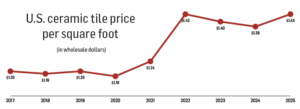
 Pricing has been an interesting mix since 2021 when the average price of tile jumped from $1.18 in 2020, which had hovered there for at least six years prior, to $1.24. Then, in 2022, it skyrocketed 15% to $1.43. The following year it dropped slightly to $1.40 and 2024 followed its downward trajectory to average about $1.38. Last year saw pricing jump back up to $1.43 as tariffs and geopolitical events began to put pressure on costs.
“Overall, tariffs and global supply chain costs continue to drive up the base cost of goods,” Emser’s Parello said.
Price increases partially explain the discrepancy between volume and sales in 2025. While the drop in sales was just above 1%, volume dropped more than 4%. “Pricing was definitely up and driven by tariffs and inflationary pressure—there were multiple price increases that happened throughout the market,” Daltile’s Maslowski said. “Margin expansion did not happen, but pricing and cost did [go up].”
Suppliers agree product mix also played a role in that discrepancy as higher-end goods sold more heavily than their entry-level counterparts. “We are seeing the higher-end consumer more resilient than the middle- and lower-end [consumer], so mix has also been trending toward higher-end products,” MSI’s Shah explained.
Looking forward
 Suppliers agree the first half of 2026 has been marred with uncertainty. Ongoing geo-political events, for example, continue to impact the industry overall. Mortgage rates, housing affordability and even prices at the gas pump and grocery aisle are putting a damper on consumer confidence and overall spending—especially when it comes to postponable purchases.
“In regard to challenges, the tariff hangover still exists, interest rates still exist, and now the energy/fuel and transportation costs have had an impact in the first part of ’26, driven by the war,” Dal-Tile’s Maslowski said. “Those have all been negatives.”
However, hope exists. “There is a fair amount of discretionary income on the sidelines where people want to either buy a new house or remodel,” Maslowski added. “So we think, as we go throughout the year, as stabilization settles in, that the back half of ’26 could still be pretty good.”
What’s more, tile remains one of only two aspirational flooring products in the industry—the other being hardwood. As such, those with available discretionary spending are turning to the category for its quality and clout. The category’s technological prowess also continues to grow, far outpacing other flooring options in terms of design and performance.
The post Stats 2026: Tile segment remains strong despite headwinds appeared first on Floor Covering News.
Stats 2026: Tile segment remains strong despite headwinds Posted First on https://fcnews.net

No comments:
Post a Comment