 The commercial flooring industry spent much of 2025 trying to find its footing. Faced with tariffs, high interest rates, labor shortages and cautious spending, the supply chain navigated a market where uncertainty often proved the biggest obstacle.
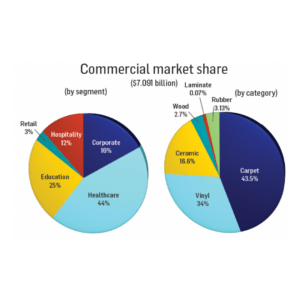
Despite the uncertainty, though, the commercial flooring sector eked out gains in 2025, rising 1% to $7.091 billion in sales, FCNews research shows.
While some sectors maintained steady demand, others hit the brakes on projects as rising costs and economic concerns reshaped investment decisions. Return-to-work mandates and corporate investment, for example, fueled office projects in select markets across the country.
“The workplace segment continues to be the leading segment for our members,” Mark Bischoff, Starnet president and CEO, told FCNews. “That’s very closely followed up by the combination of K-12 and university work.”
The healthcare segment, fueled by an aging population combined with people living longer, remains one of the more active markets. “We’ve really seen a dramatic increase in ambulatory and outpatient care work,” Bischoff noted.
That’s not to say the overall specified commercial contract market—which accounts for roughly 70% of commercial flooring activity—didn’t face its share of challenges in 2025. “Economic conditions in the form of tariffs and high interest rates impacted both the specified business and Main Street,” said Ben Elliott, Tarkett Commercial’s director, LVT product management. “High borrowing costs influence businesses of all sizes and delay both new construction and renovation projects.”
Still, several key end-use markets thrived. Here’s a look at how some of the major end-use markets shook out in 2025, along with the factors that impacted product specifications across some of the major flooring categories.
Healthcare
Healthcare remained one of the commercial market’s brightest spots in 2025, representing the largest share of business at approximately 44%, according to FCNews research. Driven by growing patient demand and the continued shift toward outpatient care, hospitals and healthcare systems invested heavily in new facilities and renovations designed to bring services closer to where people live and work. That trend fueled growth in ambulatory surgery centers, urgent care clinics and medical office buildings. It also reinforced healthcare’s reputation as a hard-surface-driven market, especially in acute care settings. Carpet tile maintains a presence in senior living communities, medical offices and behavioral health spaces where comfort and acoustics are important, according to published reports.
Infection prevention remained a key priority, influencing everything from facility design to flooring specifications. “The continued demand for hygienic, easy-to-clean and low-maintenance materials supported specification activity across outpatient facilities, medical office buildings, senior living projects and wellness-focused healthcare environments,” said Rocamador Rubio, director, Trade Commission of Spain.
But today’s healthcare spaces are about more than just function. Providers increasingly recognize the physical environment can influence patient outcomes, staff satisfaction and overall well-being, according to published reports. As a result, end users are incorporating warmer colors, nature-inspired visuals and hospitality-style aesthetics to create calmer, more welcoming settings.
“We’re seeing colors and design elements being used and trying to put both patients and healthcare workers in a state of mind that helps them to be successful,” said Yon Hinkle, AHF Products’ vice president of resilient.
Education
Education, the second-largest commercial sector with an estimated 25% market share, faced many of the same pre-COVID-19 market impacts: balanced budget pressures, changing enrollment patterns and growing demands for healthier, more adaptable environments.
K-12 schools represent the bulk of education construction activity and higher education makes up the remaining portion. The segment is increasingly embracing flexible learning environments designed for collaboration, technology integration and multipurpose use. As a result, flooring that can handle constant furniture movement, heavy foot traffic and evolving space needs are popular options.
“Ceramic tile continued performing well within corridors, cafeterias, bathrooms and shared common areas because of its longevity and ease of maintenance,” Tile of Spain’s Rubio pointed out.
Acoustics have become another key consideration. Hence the reason why carpet tile remains a go-to product in classrooms, libraries and collaborative spaces. But that is not the only solution that meets these needs.
“K-12 has now embraced LVT as an optimum product for acoustics, aesthetics and maintenance,” said Jeff Galloway, vice president, product management, Mohawk Group.
At the same time, budget concerns are forcing schools to focus on long-term value rather than upfront costs, industry observers said. Products that can be restored rather than replaced are attracting renewed attention. “We’re starting to see more demand for products like solid vinyl, particularly in education and healthcare,” said Jeff West, Shaw Industries’ SVP of brand strategy. “It’s a product you can come in and buff it and restore to its original state.”
Flooring manufacturers report growing interest in slip-resistant surfaces, products designed to withstand heavy foot traffic, and materials capable of supporting both academic and extracurricular activities. “What we are seeing in heavy traffic areas, in general, are customers in that space who became dissatisfied with the ability to keep LVT maintained or looking like new,” AHF’s Hinkle said. “Major school systems have made changes back to VCT.”
Rubber, linoleum and ceramic tile are also gaining traction as schools modernize classrooms, student housing and shared campus spaces.
These issues are influencing everything from classroom layouts to flooring choices. “There is a conscious thought with all design elements that go into those spaces,” Hinkle added. “This plays a role on how buildings are being refurbished and how new buildings are being constructed.”
Corporate/office
 The office market continued to evolve in 2025 as employers sought to bring more workers back into the office. After several difficult years, signs of recovery began to emerge. FCNews research showed this segment of the market increased its share slightly to 16% last year, up from 13% in 2024.
“The commercial market started coming back last year,” Shaw’s West said. “We started seeing activity pick up late into the year and continuing into this year.”
While office occupancy rates reached near record highs last year, the biggest changes took place inside office walls. Companies sought to reimagine existing spaces rather than expanding them, creating environments designed to encourage collaboration, flexibility and employee engagement. That shift influenced flooring choices.
“Renovation and repositioning projects within premium office environments continued supporting ceramic tile demand, particularly within lobbies, amenity spaces, cafés and collaborative common areas,” Rubio noted.
Resilient flooring, especially LVT, continued gaining share thanks to its durability, easy maintenance and attractive lifecycle costs, industry experts say. Carpet tile remained a popular option for collaborative areas because it offers design flexibility and minimal disruption during renovations. “Broadloom is losing share to carpet tile and hard surfaces in TI/property management applications,” Mohawk Group’s Galloway observed.
Overall, employee wellness emerged as a major influencer in workplace design. As companies worked to attract employees back to the office, they invested in spaces that promote comfort, better acoustics and healthier indoor environments. “The focus is on durability, acoustics and flexibility, as companies reconfigure spaces and invest in higher quality environments and more hard surface and resilient flooring products,” Starnet’s Bischoff explained.
By and large, product preferences reflected the industry’s search for value and performance. While soft surface sales decreased slightly last year, carpet tile continued gaining share, accounting for nearly 44% of commercial soft surface sales. “Customers today are balancing design, performance, sustainability and budget considerations more carefully than ever,” said Jim McKeon, vice president of sales, Interface.
Hospitality
The hospitality sector continued its slow, post-pandemic recovery as resurging leisure travel, property renovations and a growing appetite for unique guest experiences fueled investments across hotels, resorts and entertainment venues. For many operators, creating memorable spaces became a key differentiator in an increasingly competitive market.
Holding relatively steady at about 12% of commercial flooring sales, the hospitality market spans hotels, restaurants, entertainment venues and recreation facilities. Designers increasingly turn to bold patterns, custom flooring visuals and natural-inspired materials to create distinctive environments throughout lobbies, guestrooms and public spaces.
“Flooring supports design differentiation and brand experience while systems supporting room turns and refreshes are increasingly important in this highly competitive segment,” Starnet’s Bischoff said.
Take broadloom, for example. “Some hospitality spaces want large-scale patterns that are not cut and have areas where they need products over balconies and steps,” Shaw’s West said. This falls right into broadloom’s wheelhouse.
Hotels expanded beyond traditional guestrooms, adding co-working spaces, wellness centers, flexible meeting areas and social gathering spots to generate additional revenue streams. These multipurpose environments, observers say, require flooring that can perform across various uses while maintaining comfort and visual appeal. “Carpet, particularly broadloom, remains the flooring of choice for most of the hospitality industry, although LVT is becoming more common in low-mid priced chains,” Mohawk’s Galloway said.
That’s not to say that alternate materials aren’t being considered and/or utilized more frequently in these spaces. “Many mid-scale properties are replacing guest room broadloom carpet with LVT for simpler cleaning routines and longer replacement cycles,” Tarkett Commercial’s Elliott noted.
Many executives, including Interface’s McKeon, continue to see strong demand for modular flooring solutions that deliver design flexibility, performance and sustainability. Hence the reason why Broadloom maintained a strong presence in hospitality, senior living and corporate interiors.
On the hard surface side, resilient flooring remained the market leader, maintaining approximately one-third share of commercial sales, according to FCNews research.
Retail
The retail sector, the smallest of the bellwether end-use markets, continues its climb out of the post-pandemic doldrums. Estimated at less than 7% of the overall contract commercial market, brick-and-mortar retail ceded significant share to the digital realm, research shows. Still, retailers spent 2025 keeping pace with digital shopping habits while giving consumers a reason to visit physical stores. As a result, flooring played a larger role in shaping the shopping experience, helping store operators create inviting, brand-focused environments that encourage customers to linger longer.
“Mass retailers will work LVT into certain areas for a design element, such as in a grocery area or aisle,” AHF’s Hinkle pointed out. “In smaller spaces, we’re seeing a lot of LVT being utilized, and variations of engineered wood and laminates going into those spaces.”
From grocery stores to specialty boutiques, flooring choices increasingly reflected both design and durability needs. Retailers sought materials that could handle heavy foot traffic, rolling carts and frequent cleaning while maintaining a fresh appearance. “Retailers often opt for polished concrete over carpet or LVT especially in the big box stores,” Mohawk’s Galloway noted. “LVT is often the product of choice for high-traffic locations like grocery, telecommunications, food/ beverage and big boxes, while carpet remains strong in department stores and specialty retail.”
The retail landscape closed out the year with solid momentum despite economic uncertainty, according to the CNBC/ NRF Retail Monitor, powered by Affinity. Leading the charge are hard surfaces that offer long-term value. “Tile continued performing strongly within restaurants, grocery environments and mixed-use retail projects, with wood-look and stone-look porcelain surfaces remaining especially popular,” Tile of Spain’s Rubio said.
Soft surfaces continue to play an essential role, with carpet tile the leading product in areas requiring quiet and comfort. Meanwhile, polished concrete emerged as a popular option for larger retail formats seeking a cost-effective, low-maintenance solution.
“A lot of new retail work is moving to polished concrete since it is lower cost and easier to maintain,” said Geoff Gordon, executive director, Fuse Alliance.
The post Stats 2026: Commercial market seeks to find footing appeared first on Floor Covering News.
Stats 2026: Commercial market seeks to find footing Posted First on https://fcnews.net

No comments:
Post a Comment