Las Vegas—Every year The International Surface Event (TISE) serves as a barometer for where the flooring industry is headed. At this year’s show, held Jan. 27- 29 at Mandalay Bay Convention Center, the message was less about incremental change and more about purposeful evolution—particularly when it comes to how products are sold, experienced and ultimately used into the home.
For the tile category in particular that evolution moved past one-off product innovation and landed solidly in the realm of overall satisfaction—not just in the home but at the retail level as well. That meant focusing on simplifying the selection and sales process while delivering products that answered real needs—not just color trends.
But product still reigns supreme, and the latest introductions on the show floor reflected three clear priorities from tile suppliers: realism, application and domestic supply.
Supporting retail
Tile suppliers this year sharpened their focus on simplifying the path from inspiration to installation, introducing tools and products designed to make decision making easier for both consumers and retail sales associates.
Advances in visualization technology, for example, allow shoppers to see tile in realistic environments—and faster— helping eliminate guesswork and shorten the sales cycle.
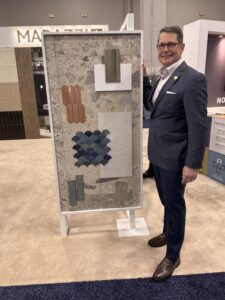
Dal-Tile, for example, has its sights set on five key pillars that each aim to support the needs of its retail partners. Those include: 1) Product; 2) Innovation; 3) Domestic production; 4) Digitization; and 5) Dealer readiness.
“No. 4 is one of the most important, and my favorite,” said Patrick Warren, vice president, residential sales, dealer and showrooms. “Digitization.” Dal-Tile’s visualizer allows users to view wall tile, backsplash, floor tile and countertops, and compare options side by side as well. What’s more, the company unveiled its new slab visualizer at the show. “The purpose of the slab visualizer is for them to actually take a look at what the slab’s going to look like. They can compare, too—be it light and dark, quartz, quartzite, granite or Panoramic. It allows them to look at everything and puts that all together.”
At the same time, a stronger presence of U.S.-made collections aims to give retailers greater confidence in availability, lead times and quality—thus smoothing the path to purchase. As such, “Made in America” messaging carried renewed weight on the show floor, reinforcing the tile category’s deep and ongoing investment in U.S.-based production—and its importance in today’s market where tariffs and supply chain uncertainty seem to dominate.

Crossville, for example, has produced its porcelain products in Crossville, Tenn., since 1986. One of its newer programs is its CrossValues collection. The collection was designed to bridge the gap between Crossville’s wide breadth of product and commercial contractors and Main Street dealers. The program includes 11 collections with 62 SKUs of its bestselling products across a good, better, best pricing strategy, which are heavily inventoried and ready to ship. “It’s Crossville’s Quick-Ship program,” explained Larry Browder, executive vice president. “It’s been the backbone of our business for the last three years, and it’s something that we’ve really built out. Contractors, retailers and designers, they’re talking about Crossville because they know we’ve got the product in stock in Crossville, Tenn. You don’t have to worry about tariffs. We can get it to you in two days. So it’s a great service proposition. And we created our CrossValues kit. So the idea here is that a contractor or a project manager can take this kit and they can put it in their truck, they can have it on their desk—they have all of the products right there at their fingertips.”
Del Conca USA officially opened its Loudon, Tenn., manufacturing facility in 2014 and has since continued to increase its capacity. Today it supplies not only porcelain tile but U.S.-made pavers for outdoor use.
“This is of course part of the growth of Del Conca USA,” said Mauricio Inglada Rubio, vice president of marketing and sales. “There are not so many domestic producers of pavers in the U.S. I think that’s an advantage that we have. And outside the house right now, people really spend money.”
Dal-Tile, too, is putting a greater focus on its Made-in- USA lineup—No. 3 in its five pillars strategy. “Eighty percent of what we sell all dealers in North America is made in the USA,” Warren said. “And that’s a big deal. It’s tariff free. And now we have an initial go-to series of displays that allow people to go into retail showrooms and buy Made in America.”
Together, these innovations reflect a broader industry shift: reducing friction in the buying process while equipping sales teams with the resources they need to guide customers toward faster, more informed purchasing decisions.
Realism rules
After decades of pursuit, realism in tile is no longer a dream. Without question suppliers at this year’s event showed off a variety of advanced technologies that blur the line between mimicry and replication. That is to say, they focused on the sensory side of flooring. Technologies in texture and glazing delivered surfaces that invite interaction, encouraging shoppers to not just see the product but feel it, too. These tactile enhancements, paired with more sophisticated visuals, reflect a broader shift toward immersive experiences that resonate with today’s consumer.
Take MSI, for example, which showcased its proprietary TileTouch Surface Technology on an expanding assortment. “People want a textural difference, and this is giving it,” said Fallon Crawford, national director of sales. “Stone looks are huge. Our DNA is natural stone, so if we’re going to be replicating natural stone, we better do it right. It’s got texture that really is reminiscent of the stone itself. You can feel the veining; you can feel the texture of the pitting where it would be in the natural stone.”
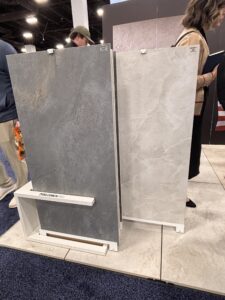
Crossville also touted its variety of surface technologies, including its Visual Touch and Feather Soft, which are available on a variety of lines including its new Portland Cliff. “The tactile aspect of it is really what’s driving people to porcelain and away from stone in many cases,” said Adam Wilkes, vice president of residential and outdoor sales. “In many high-end applications, they really feel like stone is the direction they need to go. But now when you have a product that’s far superior [in performance] and it looks like a natural stone and even feels tactile like a natural stone, then you’ve given the end user what they’re really looking for.”
Not to be outdone, Daltile also showcased new products with its Reveal Sync 3D technology alongside its other finishing technologies like StepWise and Microban. “We have tremendous innovation going on with our product development,” Warren said.
One new line on display at the show with Reveal Sync 3D technology was Sand and Stone, a terrazzo-inspired floor tile that combines marble-look chips and subtle sandstone, available in both a matte and satin finish.
Not just floors
“Driven up the wall” once served as a playful headline highlighting tile’s expansion from floor to wall applications. Today, the phrase still fits—but it barely captures the enormity of the shift. The opportunity is no longer theoretical; demand for wall, countertop and outdoor tile is accelerating at a remarkable pace.
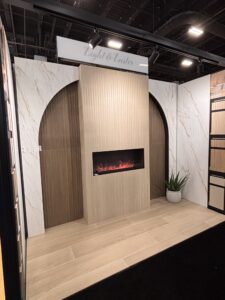
Take MSI for example. The company is touted as the second-largest supplier of tile in North America. Its No. 1 product line today? A wall tile collection called Urban Slat. “This has become our No. 1 selling tile, which is mind blowing because it’s a wall tile,” said David Raymond, senior director of sales and marketing. “When you think about that by volume, we’re selling more wall tile than we are floor tile. It was immediately popular. It was immediately a top five tile product for us, but the trend has just taken off.”
He added, “We’re seeing walls become hugely important for tile. Backsplashes have always been there, but we’re seeing paint being heavily displaced by textured tile on the wall. And I think a lot of people would look at the fluted pattern and say this is a flash in the pan trend when this is really just the tip of the iceberg.”
But the move from floors to walls isn’t where the trend stops. It’s also made its way outside—driven in large part by the demand for livable outdoor spaces that thrived during the post-pandemic years.
Del Conca USA, for example, highlighted its indoor/outdoor lines, including the new Roma line of travertine-inspired porcelain. It features a gritty, anti-slip finish and realistic textures and visuals. “This finish may save your life,” Inglada Rubio said.
While he admitted that outdoor tile has had its challenges in terms of adoption within the installer community, he also noted that its benefits far outweigh any opposition. “There were challenges with installers. They charged more to install this than natural stone—not because it’s more difficult but because it’s an unknown. But nowadays nobody wants to spend time sealing or cleaning natural stone. This is low maintenance. This you still have to clean but it’s easier. You spill some wine, you have a barbeque, and it’s no issue. No worries at all.”
Crossville, too, has focused on outdoor tile for several years now. “Every one of these new products also has an exterior finish option,” Wilkes said of the new introductions on the show floor. “It fits the trend of bringing the indoors outside and vice versa. You can have a seamless visual going from inside your house to outside, but you also have the coefficient of friction on the exterior products. We’ve really put a concerted effort on building exterior options—it’s available for the majority of the products that we’ve developed over the last three to four years. And we’re seeing that trend continue to grow.”
It was undeniable from the show floor, customer is king.
The post Surfaces ’26: Tile realism, retail-first approaches reign supreme appeared first on Floor Covering News.
Surfaces ’26: Tile realism, retail-first approaches reign supreme Posted First on https://fcnews.net

No comments:
Post a Comment