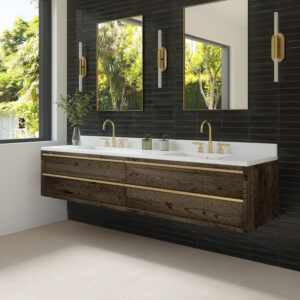
As ceramic tile looks ahead to 2026, the category is leaning hard into technology-driven innovation to broaden its appeal, sharpen its performance story and compete more effectively with alternative surfaces. From synchronized textures and dimensional finishes to ultra-thin panels, digital transformation and sustainability advances, tile manufacturers are using new technologies not only to elevate aesthetics but also to simplify installation, improve service and deliver clearer value to dealers, designers and consumers.
At Dal-Tile, for example, innovation remains central to how the company differentiates itself and drives performance in the category. According to Scott Maslowski, executive vice president of SSC sales & operations, that commitment has helped the company stay ahead of the market. “We’ve been a market leader in regard to innovation and continue to invest and push on this; we do think it’s something that differentiates us in the marketplace and has allowed us to outpace the market in regard to performance,” Maslowski told FCNews. “The last couple of years we had really a big emphasis on bringing StepWise and Microban into the market, and those had a really effective stickiness—the consumers really bought into it. It’s important that we continue to differentiate ourselves.”
Daltile’s most recent advancements focus on dimensional design and surface realism through its RevealSync3D technology, which aligns texture, structure and finish to create deeper visual impact.
“RevealSync3D technology is really giving us the ability to—both with texture and structure and different finishes—bring some different dimensionality to the product,” Maslowski said. “We think that difference is separating ourselves from the market. Just recently, we introduced Haddonstone and Indoterra, which have wildly exceeded expectations in the market. We’re really excited about where we’re going with the 3D piece of the innovation.”
Looking ahead, Maslowski said he remains optimistic about ceramic tile’s trajectory as economic conditions stabilize. “I feel good about where the tile industry is,” he said. “We just need a little tailwind from the economy to help us out. But I think 2026 and as we go into 2027, I think brighter days are ahead.”

At MSI, innovation is centered on elevating ceramic tile’s realism, performance and overall value proposition for U.S. consumers. Raj Shah, CEO of MSI, said advancements in surface technology are allowing tile to compete more aggressively with other flooring categories.
“Yes, innovation is significantly strengthening tile’s value proposition for U.S. consumers,” Shah said. “Technologies such as TileTouch Surface Technology are elevating both design and performance in meaningful ways. TileTouch delivers next generation realism by creating perfect harmony between texture and graphics, ensuring every tactile detail aligns with the visual design. This results in surfaces that not only look remarkably authentic but also feel true to the material they replicate.”
Shah noted that TileTouch works in tandem with other manufacturing advances to expand tile’s versatility across applications. “Along with improvements in digital glazing, large-format capabilities and indoor/outdoor coordinated offerings, these advancements allow ceramic tile to provide superior aesthetics, durability and versatility—making it an even more compelling choice for homeowners, designers and builders.”
MSI continues to expand TileTouch across new collections, reinforcing ceramic tile’s premium positioning. “New TileTouch-enabled collections such as Elbe, Girona and Cementique, along with earlier introductions like Cordova and Malahari, showcase this technology with elevated depth, structure and natural variation. These lines deliver sophisticated looks that resonate strongly with designers and homeowners seeking higher-end realism.”
Shah also emphasized the business impact. “For dealers and distributors, TileTouch provides meaningful differentiation, stronger storytelling on the showroom floor and higher-margin opportunities,” he said.
At AHF Products and its Crossville brand, innovation in ceramic tile is focused on enhancing sensory appeal, sustainability and installation efficiency—areas that directly address evolving market demands. Fred J. Reitz III, senior vice president of commercial, said 2025 marked a significant year for progress. “Innovation played a key role in enhancing ceramic tile’s value proposition throughout 2025,” Reitz said. “Advances in finishes like Crossville FeatherSoft and Visual Touch elevated the sensory and aesthetic experience. Digital printing enabled highly realistic wood and stone visuals, while VOC-free and carbon-neutral tiles contributed to healthier indoor environments and easier maintenance.”
Reitz highlighted ultra-thin porcelain as another major breakthrough. “Among the most notable innovations in 2025 were Gemini Panels, the thinnest porcelain surface at just 2mm, manufactured in Italy,” he said. “These panels delivered sleek aesthetics, fast installation and reduced emissions, making them ideal for both residential and commercial applications.”
Several new collections showcase how these technologies come together. “Sociale featured luxurious stone visuals with the FeatherSoft finish, offering a soft, touchable surface and indoor-outdoor flexibility,” he explained. “Sand Garden introduced Visual Touch Technology for serene, textured designs inspired by Japandi aesthetics.”
Portland Cliff, launched in 2025, also stands out as a defining example of Crossville’s innovation strategy. “Portland Cliff exemplifies innovation through its Visual Touch Technology, which replicates the tactile and visual qualities of true Portland stone,” Reitz noted. “It is carbon-neutral, made in the U.S. with up to 15% recycled content and marks Crossville’s fourth carbon-neutral collection. These innovations helped dealers and distributors meet evolving consumer demands for beauty, performance and sustainability, while offering practical benefits such as faster fulfillment and lower environmental impact.”
At Emser Tile, innovation extends beyond product design to encompass digital tools and operational efficiency—key factors in ceramic tile’s competitiveness today. Jim Parello, executive vice president of Emser Tile, said access to real-time information has become a critical differentiator.
“Digital tools, operational efficiency and supply chain transparency have become core to how the tile industry is seen,” he told FCNews. “For example, we’ve improved access to real-time information, making it easier to manage orders and inventory. This alone strengthens ceramic’s competitiveness against other materials and lets customers make faster, more informed decisions.”
Emser’s most significant advancement has been its digital transformation across Emser.com and EbyEmser.com, anchored by a fully integrated B2B platform. “It gives customers 24/7 access to all product information, pricing, inventory, ordering, payment and shipment tracking,” Parello said. “This is especially valuable in today’s market, where speed and accuracy are crucial.”
The post Innovation poised to lure consumers back to tile appeared first on Floor Covering News.
Innovation poised to lure consumers back to tile Posted First on https://fcnews.net

No comments:
Post a Comment