Domestic manufacturing has moved from a secondary consideration to a strategic imperative across the resilient flooring category. Years of freight volatility, tariff uncertainty and supply chain disruption have reshaped how manufacturers and retailers think about sourcing.
“Domestic production has become increasingly important due to a combination of supply chain disruption, rising freight costs, longer lead times and growing demand for reliability and speed to market,” said David Moore, vice president of product management at Mohawk. “Producing domestically gives us greater control over quality, inventory and responsiveness while reducing exposure to geopolitical risk and transportation volatility.”
That certainty is echoed across the industry. Eric Ruppert, senior director of product marketing and category management at Engineered Floors, said domestic manufacturing removes many of the variables that have challenged retailers in recent years. “Domestic production has shifted from a ‘nice-to-have’ to a strategic necessity,” he said. “For retailers and consumers, it provides certainty. When you manufacture in the U.S., you remove the volatility of international shipping costs, port delays and ever-changing import tariffs.”
Beyond logistics, domestic production also provides deeper insight into the category. “Domestic production is important because it builds deep knowledge and expertise in the product categories we offer and allows us to invest directly in U.S. manufacturing jobs and skills,” said Joseph Zekoski, VP of residential hard surfaces, Shaw. “Manufacturing in the U.S. enables us to develop talent, retain critical knowledge and continuously improve how products are designed, made and delivered.”
Suppliers also tout environmental benefits. “By producing in our ‘backyard,’ we reduce the carbon footprint associated with shipping heavy products halfway across the world,” Ruppert added. “Our materials travel from one end of the plant to the other before they are loaded for shipment.”
Jennifer Zimmerman, chief commercial officer, AHF Products, noted simply: “Customers increasingly value reliability and Made in USA assurance, making domestic production not just a strategic advantage but a necessity in today’s market.”
A sourcing evolution
Resilient flooring, particularly LVT/P and SPC, has historically relied on overseas production. That model, while cost-driven, has evolved as the needs of the market have, too.
“Resilient flooring has traditionally been import-driven due to lower manufacturing costs overseas,” Mohawk’s Moore said. “However, that model has shown its limitations in recent years. Domestic production in the resilient category represents a strategic shift—one focused on innovation, performance and supply chain stability rather than just cost.”
That shift has supported advancements suppliers aim to bring to market. “Domestic production allows us to be more responsive in the areas where proximity matters most—such as speed, innovation and service—while still offering the breadth, scale and value that come from a global platform,” Shaw’s Zekoski explained. “By owning key manufacturing technology and equipment, we deepen our expertise and create differentiation through unique, proprietary solutions that competitors can’t easily replicate.”
At AHF Products, domestic manufacturing has enabled a repositioning of resilient flooring. “Instead of chasing low-end imports, we’re repositioning HDPC/rigid core as a value-driven, U.S.-made product line that reinforces trust and brand strength,” Zimmerman explained.
What’s in it for retailers?
For independent flooring retailers, domestic resilient manufacturing is increasingly about business continuity and control. As supply chains remain unpredictable and market conditions shift quickly, access to U.S.-made product gives dealers more leverage to manage inventory, timing and customer expectations.
“Retailers should absolutely be looking to domestic producers in 2026,” Mohawk’s Moore said. “Capacity, technology and product breadth have evolved significantly. Domestic manufacturers are now well-positioned to support core assortments, especially in rigid and resilient categories.”
That evolution matters for dealers who need dependable replenishment and fewer surprises. “Retailers should look for partners that give them flexibility and confidence,” Shaw’s Zekoski noted. “Domestic production plays an important role, especially for speed, innovation and responsiveness. The most effective approach is one that brings these capabilities together.”
Retailers can now count on domestic production to provide volume without sacrificing quality. “Retailers can be confident that their resilient needs will be met in 2026,” AHF’s Zimmerman noted. “With over 200 million square feet of HDPC capacity—representing roughly 50% of U.S. manufacturing capacity—AHF is positioned to supply both branded and private-label solutions.”
Domestic production also allows retailers to better manage risk and respond quickly to market changes. “In 2026, retailers should be thinking less in terms of ‘domestic versus imported’ and more about supply strategy,” said Kimberly Hill, vice president of product and marketing, Novalis Innovative Flooring. “Domestic production gives retailers another tool to manage lead times, reduce risk and respond quickly to market changes, particularly in resilient flooring. While not every product will be produced domestically, having access to U.S.-made options helps ensure continuity when timing and availability are critical.”
A look at domestic capabilities
Mohawk Industries’ resilient facility centers on Renewable Polymer Core flooring. “Mohawk continues to invest heavily in domestic manufacturing, including our resilient facility,” Moore explained. “This plant leverages advanced manufacturing technology and U.S.-based raw materials. The facility is designed for scalability, allowing us to support growing demand while maintaining strict quality standards. Our focus is on innovative, sustainable resilient products that deliver durability, performance and design flexibility.”

Engineered Floors’ domestic production is anchored in Dalton, Ga. “Our heart is in Dalton, where we continue to expand our footprint in all hard and soft surfaces,” Ruppert noted. “Our dedicated hard surface facilities are specifically engineered for our PureGrain DLVT. We produce an unmatched product that is 100% waterproof and highly indentation-resistant—all under one roof.”
Shaw continues to expand its domestic footprint. “We are completing a $90 million investment that more than doubles the production capacity of our resilient manufacturing facility in Ringgold, Ga.,” Zekoski said. “This builds on more than $160 million previously invested in the facility since 2019. Beyond increased capacity, these investments are enhancing product capabilities. Broadly, RP is integrated into Shaw’s wider system of domestic manufacturing, strategic sourcing and distribution.”
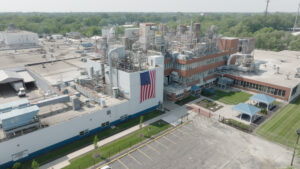
AHF Products has the largest domestic foothold in the flooring industry, with four U.S. resilient plants, now led by Cartersville, Ga. “This is a wholly owned and revitalized AHF plant,” Zimmerman said. “It delivers over 200 million square feet of HDPC capacity, representing roughly half of all U.S. rigid core manufacturing capacity.”
The company also produces VCT at its Kankakee, Ill., plant. “AHF is the only domestic manufacturer of vinyl composition tile (VCT), and we’ve been producing it in Kankakee for over 75 years,” Zimmerman added.
Novalis’ domestic footprint centers on its Dalton-based Innovation Center. “It produces SPC flooring in multiple sizes and formats for both residential and commercial applications,” Hill said. “Its role within our broader manufacturing network is to support the North American market with faster turnaround and greater flexibility, while maintaining the same quality standards across all Novalis facilities worldwide.”
Together, these investments signal a clear shift: domestic manufacturing is no longer an exception in resilient flooring but a defining strength.
The post Domestic manufacturing reshapes resilient category appeared first on Floor Covering News.
Domestic manufacturing reshapes resilient category Posted First on https://fcnews.net

No comments:
Post a Comment